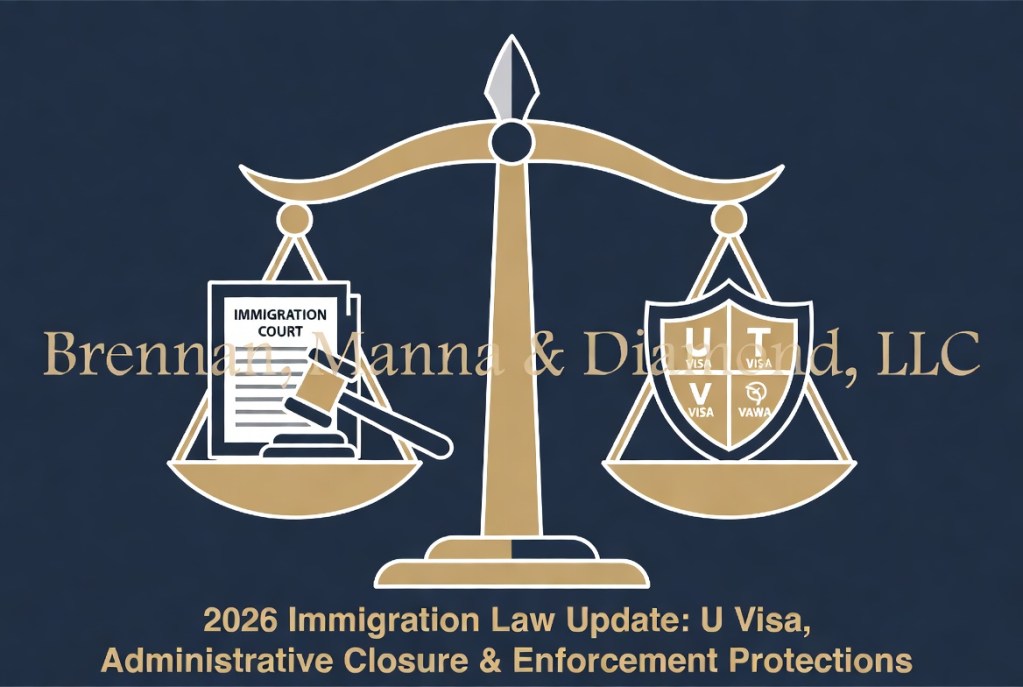
Three 2026 Decisions Reshape Administrative Closure and Protections for Pending U, T, and VAWA Cases
In the first half of 2026, three significant legal developments substantially altered the landscape for immigration cases involving pending U visas, T visas, and VAWA self-petitions. Two decisions sharply restrict the use of administrative closure, while one provides meaningful (though preliminary) protections against certain ICE enforcement actions. Together, they create a more challenging environment for individuals whose primary or only potential relief lies in one of these humanitarian petitions.
1. Matter of Ibarra-Vega and Related BIA Authority (February 2026)
In Matter of Sandra Ibarra-Vega, 29 I&N Dec. 476 (BIA 2026), the Board of Immigration Appeals sustained DHS’s interlocutory appeal and ordered recalendaring of a long-administratively-closed removal case.
Key holdings:
When a U visa is not immediately available and the record does not establish that one is likely to become available in the reasonably near future, administrative closure over DHS objection is inappropriate.
The “reasonably short period of time” standard from Matter of B-N-K- applies to both the initial decision to administratively close a case and the decision to recalendar it.
Immigration Judges and the Board lack authority to use administrative closure as a de facto extra-statutory form of relief that effectively grants amnesty to removable noncitizens who may become eligible for a visa in the future.
Absent unique circumstances specific to an individual case, administrative closure in excess of six months is presumptively unreasonable.
A companion decision, Matter of Medina-Madrid, 29 I&N Dec. 514 (BIA 2026), applied the same framework to a provisional unlawful presence waiver case. Matter of Pinzon Rozo, 29 I&N Dec. 507 (BIA 2026), extended similar scrutiny to continuance requests in SIJS cases where no visa number is immediately available. These decisions signal that the Board is applying a more restrictive approach across multiple forms of collateral relief with long wait times.
2. Immigration Center for Women and Children v. Noem (C.D. Cal., May 20, 2026)
In ICWC v. Noem (Case No. 2:25-cv-09848-AB-AS), the U.S. District Court for the Central District of California granted significant preliminary relief in a class action challenging a January 2025 ICE enforcement policy that had reversed prior victim-centered protections.
Key holdings:
The court stayed the 2025 ICE guidance (often called the Vitello Memo or ICE Policy 11005.4) along with two related practices: “de facto revocation” of deferred action without notice or opportunity to be heard, and “blind removal” of individuals with pending U or T petitions without first obtaining a prima facie eligibility determination from USCIS.
The court preliminarily certified three nationwide classes covering people with pending VAWA, U, or T petitions who are detained or subject to detention; individuals with deferred action facing enforcement without proper process; and individuals who requested stays of removal after January 30, 2025.
Relief was granted through an APA § 705 stay of the challenged policies rather than a traditional classwide injunction. This mechanism was chosen in light of statutory limits on certain immigration injunctions. The stay operates on the policies themselves and provides broad practical protection for class members.
The government may appeal the decision. The court deliberately used the APA stay mechanism to deliver meaningful relief while navigating Supreme Court precedent limiting nationwide injunctions.
3. State of Texas v. Department of Justice (N.D. Tex., June 22, 2026)
In a consent judgment entered the same day the complaint was filed, the U.S. District Court for the Northern District of Texas vacated the May 2024 EOIR rule “Efficient Case and Docket Management in Immigration Proceedings.”
Key holdings:
The court declared the rule in excess of statutory authority and contrary to law.
It held that no statute authorizes immigration judges to indefinitely administratively close or suspend adjudication of removal cases.
The court permanently enjoined the DOJ and EOIR from enforcing the rule or promulgating substantially similar regulations.
The parties waived any right to appeal.
Because this was a coordinated consent judgment rather than contested litigation, it signals that EOIR under the current administration has limited institutional interest in preserving the expanded administrative closure framework created by the 2024 rule.
How the Three Decisions Interact
These decisions largely reinforce one another and operate on two distinct tracks:
Inside EOIR (case management and closure): The Texas consent judgment and the BIA decisions (Ibarra-Vega, Medina-Madrid, and Pinzon Rozo) work together to significantly restrict administrative closure. The Texas decision eliminated the regulatory expansion that made closure easier. The BIA decisions added strong precedent limiting its use for cases with lengthy backlogs and establishing a presumptive six-month reasonableness standard.
Outside the removal hearing (ICE enforcement and detention): ICWC v. Noem provides counterbalancing protection on the enforcement side. While tools for pausing cases inside EOIR have been curtailed, this decision gives practitioners stronger arguments to challenge detention and certain ICE removal actions while a U, T, or VAWA petition remains pending.
Overall effect: There is now greater pressure to move removal cases toward completion on the merits or through termination (where DHS agrees), rather than relying on long-term administrative closure. At the same time, ICWC v. Noem offers improved tools to protect clients from detention during the pendency of humanitarian petitions.
Impact on Individuals Whose Only or Primary Relief Is a Pending U, T, or VAWA Petition
For people — particularly recently detained individuals — whose main or only potential relief is a pending U visa, T visa, or VAWA self-petition, the combined impact is significant:
Administrative closure is now a much weaker and riskier strategy, especially in cases with any meaningful backlog.
Fighting detention and ICE enforcement has become relatively stronger due to ICWC v. Noem.
The removal case itself is more likely to proceed to a merits hearing. A pending U, T, or VAWA petition is not a defense to removability.
Avoiding actual removal now depends more heavily on either DHS exercising prosecutorial discretion or obtaining relief through federal court.
Current Best Options and Recommendations
For clients in this situation, the strongest current strategies include:
Aggressively leverage ICWC v. Noem: File or renew bond motions and stay requests that explicitly cite the APA stay and class membership. This is currently the clearest protection against detention and certain enforcement actions.
Prioritize USCIS processes: Push for a bona fide determination and placement on the U visa waiting list where appropriate. Note that USCIS generally grants BFD-based deferred action only to individuals physically present in the United States.
Use targeted, time-limited continuances rather than broad administrative closure: When seeking delay, present strong evidence of prima facie eligibility and tie the request to a specific, reasonable timeframe. Be prepared to address the recent BIA decisions.
Pursue termination where facts support it: Joint motions to terminate with DHS/OPLA remain one of the cleanest resolutions when equities are strong.
Consider federal court relief early in appropriate cases, particularly where detention is prolonged or removal is imminent.
Maintain strong equities and documentation: With fewer procedural tools for long-term pauses, thorough case preparation and compelling equities carry greater weight.
These three decisions reflect a more restrictive environment for administrative closure paired with targeted protections against certain enforcement actions. The landscape remains fluid. Practitioners should monitor further developments from EOIR, the Ninth Circuit, and any new BIA precedent.
Recent Post
-
 IF YOUR TPS IS ENDING, CAN YOU QUALIFY FOR CANCELLATION OF REMOVAL?
 -
 U, T and VAWA visas no longer an automatic and indefinite stay of removal.
 -
 NEW USCIS POLICY WILL AFFECT ALL H-1B HOLDERS
 -
Were you brought to the United States without your knowledge or consent, or forced to come here?
-
 THE NEW TOOL FOR STATE AND COUNTY PROSECUTORS TO TRIGGER FEDERAL DEPORTATION